Visit to Habitat Homes

As you have probably heard, a group of six congregation members were able to tour three Habitat for Humanity projects in King County last week. You will see pictures from all the sites elsewhere in this newsletter. Overall, the group that visited was impressed with the way the homes fit into the neighborhood and the quality of the construction used. One of our church members commented that they were surprised that they didn’t feel sterile, even though they are more dense than typical single family homes.
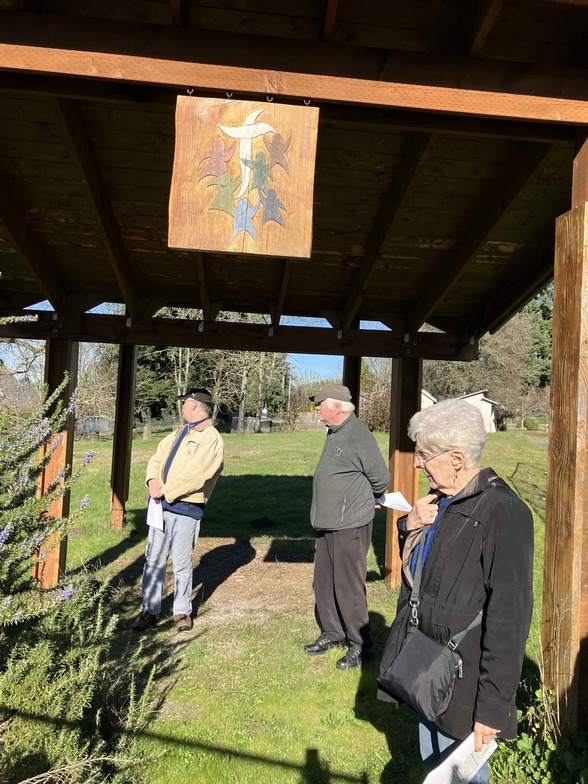
First, we visited the Bellevue Gardens site, which has yet to break ground. This is the former site of the Holy Cross Lutheran Church near Factoria. Holy Cross ran a P Patch and an orchard, both of which were very important to them to preserve. They also had a pergola they had constructed that is rich with artwork important to their congregation which also collects rain water for use in the gardens, which will also be preserved. This project has just been fully funded and removal of pre-existing structures will begin soon. When the church started their work with Habitat, they had a plan to remain a worshiping body on the site and then they changed their plan and dissolved as a church and sold their entire lot to Habitat. They formed a non-profit to manage the P Patch and the orchard and Habitat will develop the rest of the lot.
Our next stop was the Yarrow Cottages project in White Center, which is next door to the Yarrow Townhomes project. Yarrow Cottages is completed and many of the units have residents living in them. Yarrow Townhomes has foundations laid and will be having work parties in coming weeks to get the framing done and begin to add electrical and plumbing systems. At Yarrow Cottages, we could see a finished townhome that did not have a buyer yet. The appliances were all new and the space felt like it was ready to welcome its new owner. Also at Yarrow Cottages, we visited the volunteer staging area where safety equipment and everything a volunteer would need are kept secure.
Finally, we went to Burien to visit the Miller Creek project. It has recently finished construction and was having inspections the day we visited, but no residents have moved in yet. There was a large courtyard with parking and a play structure in the center of this and a wetland that was preserved on one end of the development. Here we were able to go inside several units, including an ADA unit with a bedroom on the ground floor.
Some of the important learnings we brought back with us will inform our conversations and processes this spring as we take next steps toward a possible agreement with Habitat to develop affordable housing at our church. I don’t have space here to detail all our learnings, so I’ll just give an example. We learned a little about how they establish a sale price for a new home they have constructed. They build what they call a “funding stack” to assemble whatever grants are possible to build the homes and then they pay the other expenses that are not covered by the funding stack. Their expenses, minus the funding stack is divided by the number of homes and determines the base price for the units. All homeowners have to be able to pay at least that amount to qualify to buy a home. However, not all homeowners pay exactly the base price. The way they actually calculate the sale price for a homeowner is that the homeowner’s actual income is taken into consideration and homeowners are matched with mortgages so that their monthly payments are about 35% of their monthly income.
I’m hopeful that over the next several weeks, we will all continue to listen and learn so whatever decisions we come to are based on the best information possible and help us to trust that we are being guided by God, who accompanies us faithfully in this season.